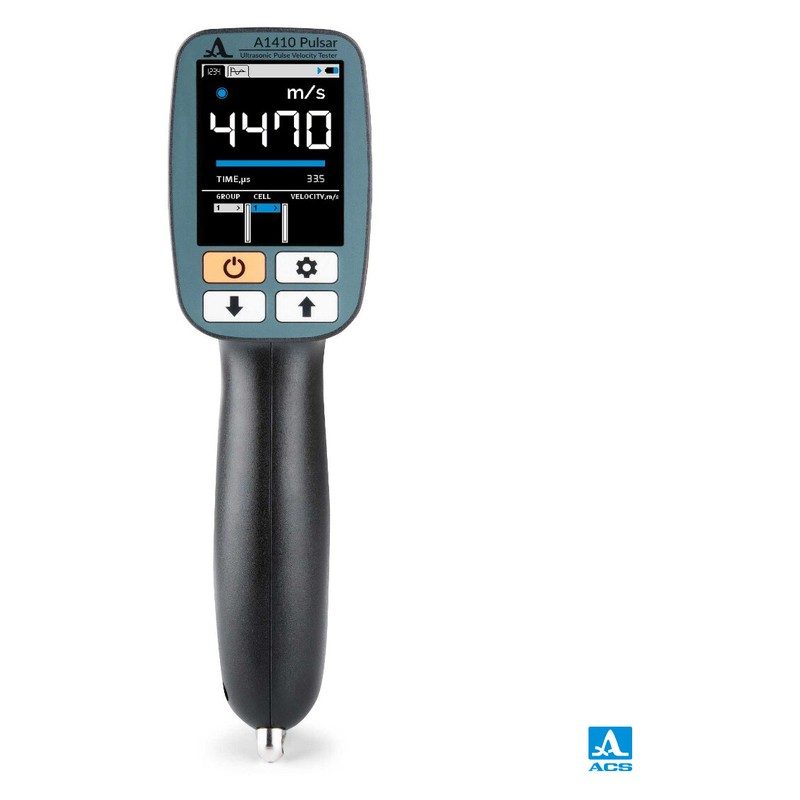
A couplant-free ultrasonic pulse velocity tester for concrete. Dry-point-contact transducer arrays measure pulse velocity and travel time by through-transmission, indirect and surface methods, across thicknesses up to 2.5 m (material dependent).
Tell us your city and country. We reply with a formal quotation covering price, delivery terms and lead time.
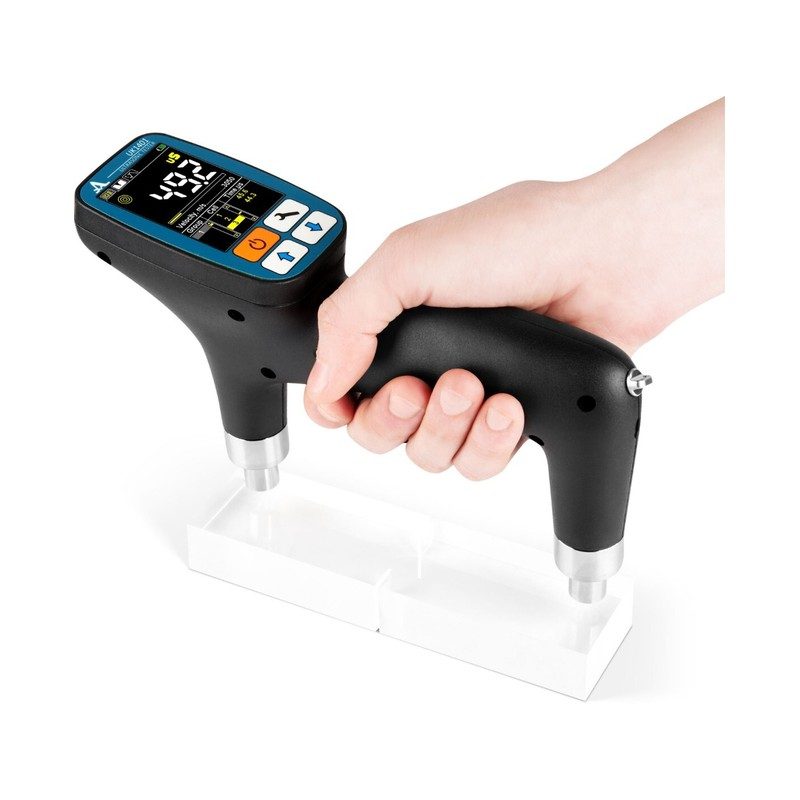
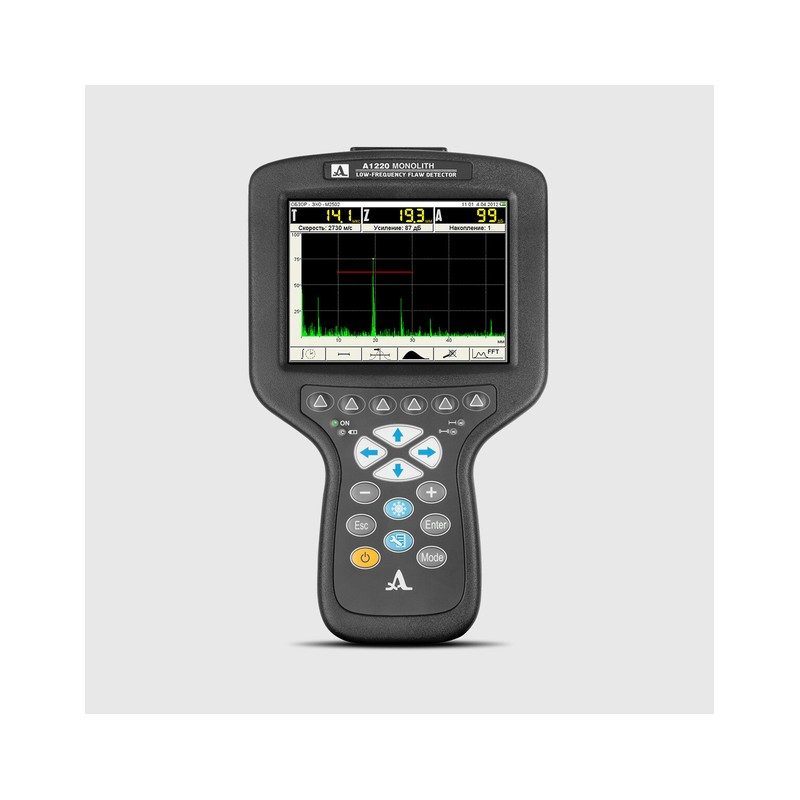
The A1410 PULSAR measures the propagation time and velocity of longitudinal ultrasonic waves through concrete. A transmitting array and a receiving array of seven dry-point-contact (DPC) transducers each, in a daisy-wheel pattern, work dry: no couplant gel and no surface preparation. It supports direct (through-transmission), indirect and surface arrangements, with an adjustable base of 50 to 2,500 mm.
Pulse velocity is an indicator of the uniformity and condition of concrete, and it is used to locate cracks and cavities where a signal is delayed or lost. The manufacturer's manual refers to its use in strength evaluation according to the relevant standards. The PULSAR does not measure compressive strength directly. A strength estimate needs a correlation or calibration built for your own concrete, for example against cored samples. It does not establish load-carrying capacity or structural safety, and it is not a rebar scanner.
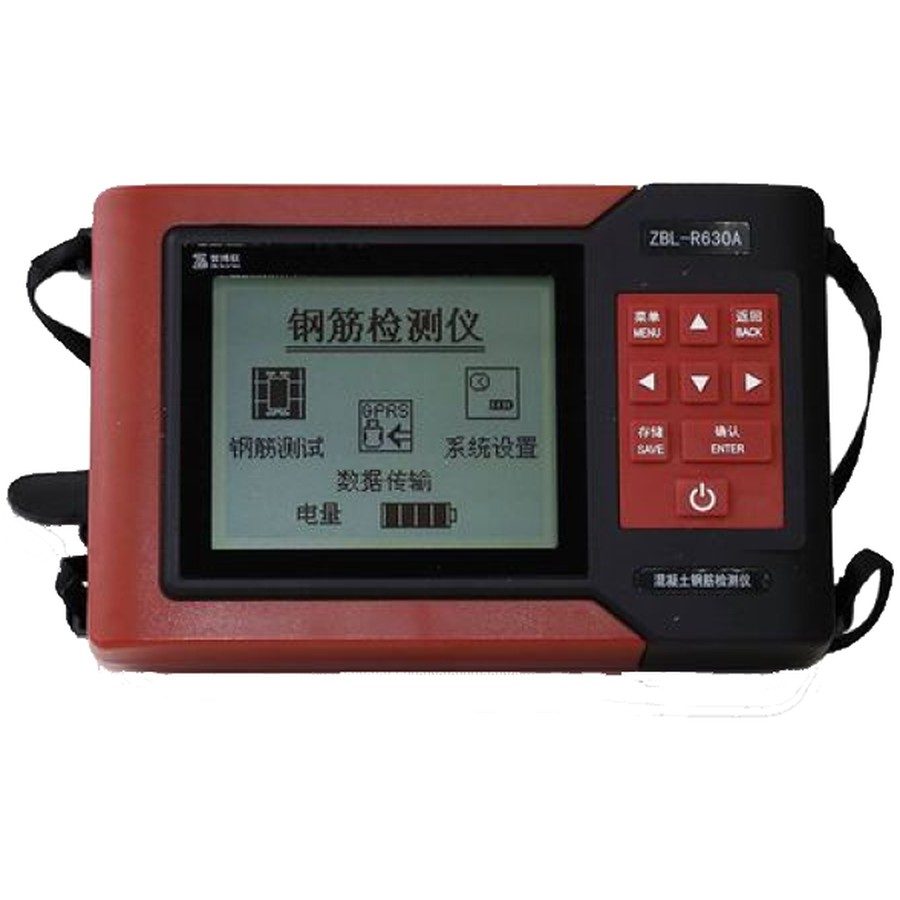
| A1410 PULSAR | UK1401 SURFER | ZBL-R630A | |
|---|---|---|---|
| What it measures | Pulse velocity and transit time: through-transmission, indirect and surface | Surface pulse velocity and transit time | Reinforcement position, concrete cover, bar diameter |
| Measuring base | Adjustable, 50 to 2,500 mm | Fixed, 150 mm | Not applicable |
| Access needed | Both faces for direct through-transmission | One face | One face |
| Transducers | Separate transmitting and receiving DPC transducer arrays | Two built-in DPC transducers | Probes using electromagnetic induction |
| Finds rebar | No | No | Yes (its purpose) |
| Best known for | Through-transmission up to 2.5 m (material dependent) | Compact one-hand surface checks | Locating bars before coring or drilling |
* Maximum thickness depends on the concrete. Source: ACS A1410 PULSAR operation manual and brochure. Time range and accuracy figures differ between ACS documents, so they are not shown here. Ask us for the current datasheet with your quotation.
Opens the manufacturer's or publisher's own document in a new tab. Ask us for the current datasheet with your quotation.
Afroil supplies the A1410 PULSAR to order, with delivery to your location. We do not hold local stock, so every purchase starts with a quotation.
Payment arrangements, warranty and manufacturer support terms are confirmed in your quotation, so you see them before you commit.
Not directly. It measures ultrasonic pulse velocity and travel time. Strength can be estimated from velocity only with a correlation built for your own concrete, for example against cored samples. It does not determine structural safety or load-carrying capacity.
The PULSAR has separate transmitting and receiving arrays with an adjustable base, so it can test through a member. The SURFER is a one-piece surface tester with a fixed 150 mm base. See the full comparison.
No. The dry-point-contact transducers work without couplant or surface preparation.
No. Reinforcement near the test path can affect readings, but the instrument does not locate bars. Use a rebar locator such as the ZBL-R630A. See rebar scanner vs ultrasonic concrete tester.
The price depends on your location and the configuration, so we quote each order. Send your city and country and we reply with a formal quotation covering price, delivery terms and lead time. Nigeria and Ghana are quoted separately.
No. We supply to order from the manufacturer, and the quotation sets out the delivery arrangement.
Describe the material, component, inspection objective and site conditions. Our team will recommend suitable equipment and prepare a quotation covering price, estimated delivery and lead time.
Speak with us on WhatsApp